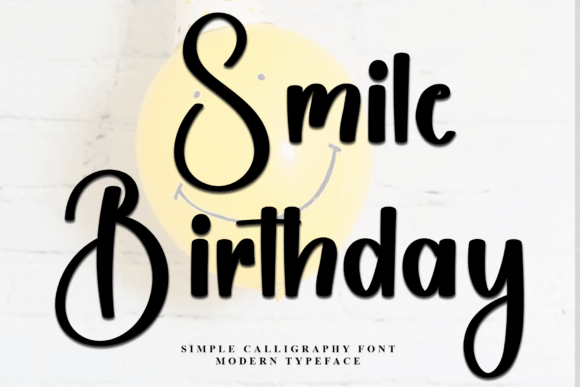
Smile Birthday: A Strategic Choice for Celebratory Communication
Smile Birthday isn’t just another script font—it’s a deliberate design decision with measurable impact. Its exuberant, bold calligraphy style features strong, rounded strokes and a lively, confident rhythm that reads instantly as joyful, approachable, and human-made. Unlike overly ornate scripts that sacrifice legibility or minimalist sans-serifs that mute emotional tone, Smile Birthday occupies a precise strategic niche: it communicates celebration *without ambiguity*, at scale, across mediums, and to diverse audiences. For professionals who manage brand voice, customer touchpoints, or visual storytelling—whether launching a product, designing an event campaign, or building educational materials for children—choosing Smile Birthday is less about aesthetics and more about aligning typography with intention.
Why Smile Birthday Fits Real-World Goals—Not Just Design Trends
When you’re balancing tight timelines, limited budgets, and high expectations, every creative choice must serve multiple functions. Smile Birthday does exactly that. Its inherent readability—achieved through generous x-height, open counters, and consistent stroke weight—means it performs well in both digital and print contexts: from Instagram story text overlays to vinyl-cut party banners. That reliability reduces revision cycles and production delays. More importantly, its cheerful character supports psychological goals: research in applied typography shows that rounded, high-contrast scripts like Smile Birthday increase perceived warmth and approachability—critical when onboarding new customers, welcoming students, or softening promotional messaging. It doesn’t shout; it invites. And in crowded digital feeds or retail environments, that invitation often translates directly into attention retention and engagement lift.
Where Smile Birthday Delivers Measurable Value
- Birthday cards and invitations: Replaces generic clipart or overused fonts with a cohesive, ownable voice—especially valuable for small businesses selling custom stationery or event planners offering branded packages.
- Children’s products and learning tools: Its friendly proportions and clear letterforms support early literacy development while reinforcing positive emotional associations with learning activities.
- Local business promotions: Cafés, toy stores, or family-friendly studios use Smile Birthday in window decals or social posts to signal community warmth—differentiating themselves from corporate competitors without sounding childish.
- Educational content for young audiences: Teachers and edtech creators apply it selectively in slide headers or worksheet titles to signal “this part is fun” or “this is safe to explore”—a subtle but effective cognitive cue.
Strategic Use Starts With Constraints—Not Creativity
Using Smile Birthday effectively means respecting its scope. It excels in display roles—not body copy. Attempting to set full paragraphs in Smile Birthday undermines its strength and sacrifices accessibility. Instead, treat it as a focused instrument: deploy it where hierarchy, emotion, and memorability matter most. Ask yourself before applying it: What action do I want the viewer to take? What feeling should anchor that action? If the answer is “feel excited about this birthday party,” “recognize this brand as warm and inclusive,” or “trust that this learning activity is joyful and safe,” then Smile Birthday is a sound tactical match. But if the goal is neutrality, formality, or technical precision—choose elsewhere. Misalignment here doesn’t just weaken impact; it erodes credibility.
Planning Your Implementation: Three Practical Considerations
- Pair intentionally: Smile Birthday gains authority when anchored by a clean, highly legible sans-serif (e.g., Inter, Poppins, or Open Sans) for supporting text. This contrast creates visual breathing room and reinforces hierarchy—no need to explain tone when the type pairing does it silently.
- Test at real size and context: A font that looks energetic on a desktop preview may read as cluttered on mobile or illegible at 12 pt on packaging. Print a physical mockup. View it on a phone screen in natural light. Observe how it holds up next to photography or solid color backgrounds.
- Consider licensing and scalability: Verify usage rights for your specific channel—especially for commercial merchandise, video intros, or embedded web fonts. Some versions of Smile Birthday require extended licenses for app or SaaS integration. Budgeting for proper licensing avoids legal friction later—and ensures consistent rendering across platforms.
Risks of Using Smile Birthday Without Clear Intent
Typography without strategy becomes decoration—and decoration rarely drives results. When Smile Birthday is used reactively (“it looked fun in the preview”), it risks undermining messaging clarity. For example, applying it to a serious nonprofit announcement about childhood nutrition could unintentionally trivialize the cause. Similarly, overusing it across all brand touchpoints dilutes its celebratory power—like playing a fanfare at every meeting. Worse, inconsistent application (e.g., using different weights or spacing across social posts vs. email headers) signals operational disorganization, not creativity. These aren’t minor details. They shape perception—often subconsciously—and influence whether someone trusts your judgment enough to buy, enroll, or collaborate.
Long-Term Positioning: Beyond the Birthday Card
Think beyond single-use applications. Smile Birthday can become part of a broader visual language system—especially for brands built around joy, growth, or human-centered experiences. A pediatric clinic might use it only in patient welcome signage and family handouts, reinforcing empathy without compromising clinical professionalism elsewhere. An indie publisher of children’s books could license it as a signature title treatment, creating instant recognition across their catalog. The key is consistency within boundaries: define *where* and *why* Smile Birthday appears—and stick to those rules. That discipline builds recognition faster than random variation ever could. Over time, audiences begin associating its rhythm and warmth with your values—not just your events.
Making Smarter Decisions, Not Just Bolder Ones
Choosing Smile Birthday shouldn’t be about chasing trendiness or filling a design gap. It should follow a quiet, practical logic: Does this font help me communicate the right message, to the right people, in the right moment—with minimal friction and maximum resonance? When used with that question in mind, Smile Birthday supports outcomes—not just outputs. It shortens the path between idea and understanding. It lowers cognitive load for viewers scanning quickly. It reinforces brand personality without requiring explanation. And for time-constrained professionals—freelancers juggling five clients, educators preparing lessons after school, small business owners managing every detail—it delivers reliable, repeatable value without demanding extensive typographic expertise.
That’s the real advantage: Smile Birthday doesn’t ask you to become a font expert. It asks you to clarify your intent first—and then gives you a tool calibrated to deliver on it. Used that way, it’s not just a font. It’s a lever.